Friday, May 27, 2011

Night sky images

Hi Guys,

I installed chdk in canon A700.(CHDK is excellent hack which enables many DSLR-like features in canon digital cameras.you can find all info about CHDK here).With CHDK I could take exposures upto 64 seconds. results are better then expected. See images below. Click the Image for larger version.

Draco

Hercules,Coma Boralis & Part of Bootes

Lyra,Hercules & Part of Ophiuchus

Scorpius

Hercules,Draco,Lyra & Part of Cygnus

Hercules,Coma Borealis,Bootes & Part of Ophiuchus

Ursa Major


Saturday, April 30, 2011

New Equipment Added

I added new 25mm GSO Plossl(click here for details) to my collection..its giving excellent results..taking pics of planets and moon through digital cameras will be easier now. will try and upload the pics soon..stay tuned..

Friday, April 15, 2011

Moon Images(Processed with Registax)

Hi guys,

Yesterday night sky was clear so I tried record moon. With cheap webcam I was not getting satisfactory results, therefore I tried to process the images with a great freeware called Registax(you can download it from here). Though it was my first ever attempt with registax, I found it very easy to use and effective. Results are as below.

Before Processing


After Processing


Thursday, March 31, 2011

Moon through telescope and webcam

few weeks before I tried to record moon and other planets through my 4 inch reflector telescope and a webcam..results are following...videos are bit shaky as it was my 1st attempt...

Moon


Saturn


Jupiter & its Moons

Monday, November 8, 2010

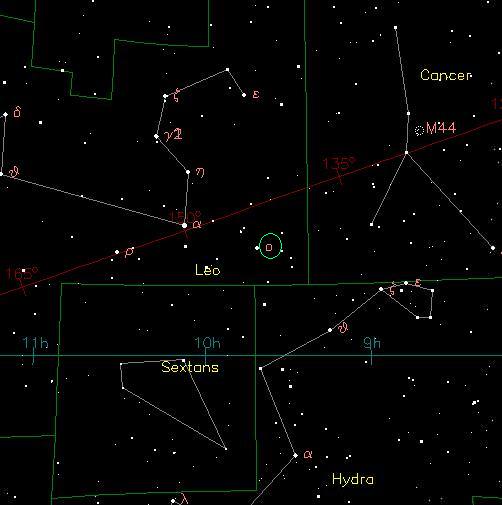
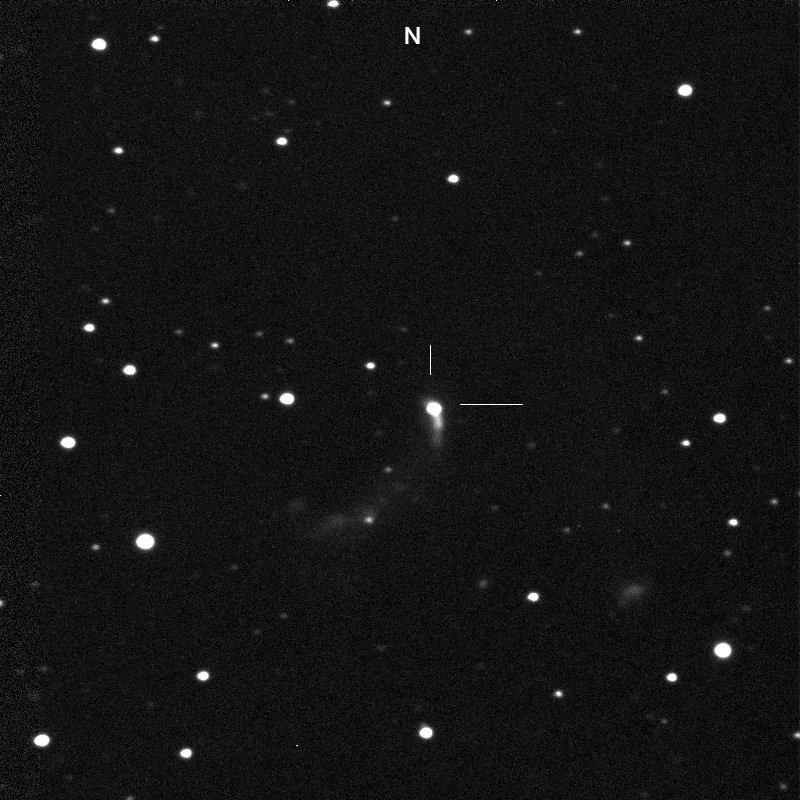
New Supernova Lights Up Leo


A new supernova? Darn right. Lighting up Leo? Well… not without some serious visual aid, but the fact that someone out there is watching and has invited us along for the ride is mighty important. And just who might that someone be? None other than Tim Puckett.
Less than 24 hours ago, the American Association of Variable Star Observer’s Report #222 stated:
“Bright Supernova in UGC 5189A: SN 2010jl
November 5, 2010
We have been informed by Tim Puckett and by the Central Bureau for Astronomical Telegrams (CBET 2532, Daniel W. E. Green, Ed.) of the discovery of a bright supernova in UGC 5189A by J. Newton and Puckett, Portal, AZ, on November 3.52 UT at unfiltered magnitude 13.5. Confirming images (limiting magnitude 19.1) by Puckett on Nov. 4.50 UT showed the object at magnitude 12.9.
Spectroscopic observations (CBET 2536, Daniel W. E. Green, Ed.) by S. Benetti and F. Bufano, Istituto Nazionale di Astrofisica, Osservatorio Astronomico di Padova, on behalf of a larger collaboration, and by J. Vinko, University of Szeged, G. H. Marion, Harvard-Smithsonian Center for Astrophysics and University of Texas, T. Pritchard, Pennsylvania State University, and J. C. Wheeler and E. Chatzopoulos, University of Texas, show that SN 2010jl is a type-IIn supernova. Vinko et al. also report that simultaneous measurements with Swift/UVOT in the ultraviolet bands confirm that the transient is ultraviolet-bright, as expected for young, interacting supernovae.
Coordinates: 09 42 53.33 +09 29 41.8 (J2000.0) This position is 2.4″ east and 7.7″ north of the center of UGC 5189A. This AAVSO Special Notice was prepared by Elizabeth O. Waagen.”

While magnitude 12-12.9 isn’t unaided eye bright by a long shot, it’s well within the reach of most of today’s backyard telescopes. The image you see here on the right is of UGC 5189A before the event and the lefthand image was taken at the time of the supernova report. Visually the SN event outshines the galaxy! While chasing a faint supernova event might not be everyone’s cup of tea, Mr. Puckett’s devotion is absolutely legendary and I strongly encourage you to have a look if you have the the tools and talent.
So many supernovae… So little time!

Thursday, September 30, 2010

New Earth-sized Exoplanet is in Star’s Habitable Zone


Artist illustration of a super Earth around Gliese 581
An enticing new extrasolar planet found using the Keck Observatory in Hawaii is just three times the mass of Earth and it orbits the parent star squarely in the middle of the star’s “Goldilocks zone,” a potential habitable region where liquid water could exist on the planet‘s surface. If confirmed, this would be the most Earth-like exoplanet yet discovered and the first strong case for a potentially habitable one. The discoverers also say this finding could mean our galaxy may be teeming with prospective habitable planets.

“Our findings offer a very compelling case for a potentially habitable planet,” said Steven Vogt from UC Santa Cruz. “The fact that we were able to detect this planet so quickly and so nearby tells us that planets like this must be really common.”
Vogt and his team from the Lick-Carnegie Exoplanet Survey actually found two new planets around the heavily studied red dwarf star Gliese 581, where planets have been found previously. Now with six known planets, Gliese 581 hosts a planetary system most similar to our own. It is located 20 light years away from Earth in the constellation Libra.
The most interesting of the two new planets is Gliese 581g, with a mass three to four times that of the Earth and an orbital period of just under 37 days. Its mass indicates that it is probably a rocky planet with likely enough gravity to hold on to an atmosphere.
The planet is also tidally locked to the star, meaning that one side is always facing the star in sunlight, while the side facing away from the star is in perpetual darkness. One effect of this is to stabilize the planet’s surface climates, according to Vogt. The most habitable zone on the planet’s surface would be on the terminator, the line between shadow and light, with surface temperatures decreasing toward the dark side and increasing toward the light side.
“Any emerging life forms would have a wide range of stable climates to choose from and to evolve around, depending on their longitude,” Vogt said.
There has been debate about the other planets found previously around Gliese 581, whether they could be habitable or not. Two of them lie at the edges of the habitable zone, one on the hot side (planet c) and one on the cold side (planet d). While some astronomers still think planet d may be habitable if it has a thick atmosphere with a strong greenhouse effect to warm it up, others are skeptical. The newly discovered planet g, however, lies right in the middle of the habitable zone.
“We had planets on both sides of the habitable zone–one too hot and one too cold–and now we have one in the middle that’s just right,” Vogt said.
The researchers estimate that the average surface temperature of the planet is between -24 and 10 degrees Fahrenheit (-31 to -12 degrees Celsius). Actual temperatures would range from blazing hot on the side facing the star to freezing cold on the dark side.
If Gliese 581g has a rocky composition similar to the Earth’s, its diameter would be about 1.2 to 1.4 times that of the Earth. The surface gravity would be about the same or slightly higher than Earth’s, so that a person could easily walk upright on the planet, Vogt said.
The planet was found using the HIRES spectrometer (designed by Vogt) on the Keck I Telescope, measuring the star’s radial velocity. The gravitational tug of an orbiting planet causes periodic changes in the radial velocity of the host star. Multiple planets induce complex wobbles in the star’s motion, and astronomers use sophisticated analyses to detect planets and determine their orbits and masses.
“It’s really hard to detect a planet like this,” Vogt said. “Every time we measure the radial velocity, that’s an evening on the telescope, and it took more than 200 observations with a precision of about 1.6 meters per second to detect this planet.”
In addition to the radial velocity observations, coauthors Henry and Williamson made precise night-to-night brightness measurements of the star with one of Tennessee State University’s robotic telescopes. “Our brightness measurements verify that the radial velocity variations are caused by the new orbiting planet and not by any process within the star itself,” Henry said.
The researchers also explored the implications of this discovery with respect to the number of stars that are likely to have at least one potentially habitable planet. Given the relatively small number of stars that have been carefully monitored by planet hunters, this discovery has come surprisingly soon.
“If these are rare, we shouldn’t have found one so quickly and so nearby,” Vogt said. “The number of systems with potentially habitable planets is probably on the order of 10 or 20 percent, and when you multiply that by the hundreds of billions of stars in the Milky Way, that’s a large number. There could be tens of billions of these systems in our galaxy.”
Source: University of California – Santa Cruz

Wednesday, September 29, 2010

ASTRONOMICAL EVENTS FOR OCTOBER 2010


Oct 1: Comet 103P Hartley is just 1 deg 37’ from Alpha Cassiopeia

Oct 1: Saturn Conjunction

Oct 1: Last Quarter Moon

Oct 5: A Waning Crescent Moon stands within 6 degrees from Regulus in East just before dawn

Oct 7: Mars is just 41’25” from a 2.7th mag star Alpha Librae after sunset in West

Oct 7: Comet 103P Hartley is just 1.5 deg away from “Double Clusters” in Perseus. Great opportunity for astro-photographers!!

Oct 8: New Moon

Oct 8-9: Draconids Meteor Shower will peak in a New Moon night. Expect a peak rate of 10 meteors per hour under clear, moonless conditions.

Oct 11: A Waxing Crescent Moon is just 2 degrees from Antares in West at the time of evening

Oct 15: First Quarter Moon

Oct 17: Mercury Superior Conjunction

Oct 18: Comet 103P Hartley is within 3 degrees south of brilliant Capella

Oct 20: The Moon is within 8 degrees from Jupiter

Oct 20: Comet 103P Hartley is closest to Earth by distance of 0.12 AU.

Oct 21-22: Orionids Meteor Shower will peak in presence of a Waxing Gibbous (95% illuminated) Moon. This shower produces a peak rate of 20 meteors per hour.

Oct 23: Comet 103P Hartley is just 1.5 deg from the Open Cluster M37 after midnight

Oct 23: Full Moon

Oct 25: The Moon is just about 4 degrees from M45

Oct 26: Comet 103P Hartley is 3 degrees from a rich open cluster M35 in Gemini after midnight

Oct 29: Venus Inferior Conjunction

Oct 30: Last Quarter Moon


THIS MONTH’S PLANET ROUND-UP


VENUS: Very low in the evening sky. The planet will be on Inferior Conjunction on 29th October.

MARS: Along with Venus, Mars is very low in the evening sky at West. Mars will be just 41’25” from a 2.7th mag star Alpha Librae on 7th.

JUPITER: Jupiter will be visible for most of the time of night during October. The planet URANUS will remain close with Jupiter.

SATURN: The ringed world will emerge from the early morning eastern sky around 20th August. The planet will be very close to Gamma Virginis star.

MERCURY: Mercury will be on Superior Conjunction on 17th.